1 min read
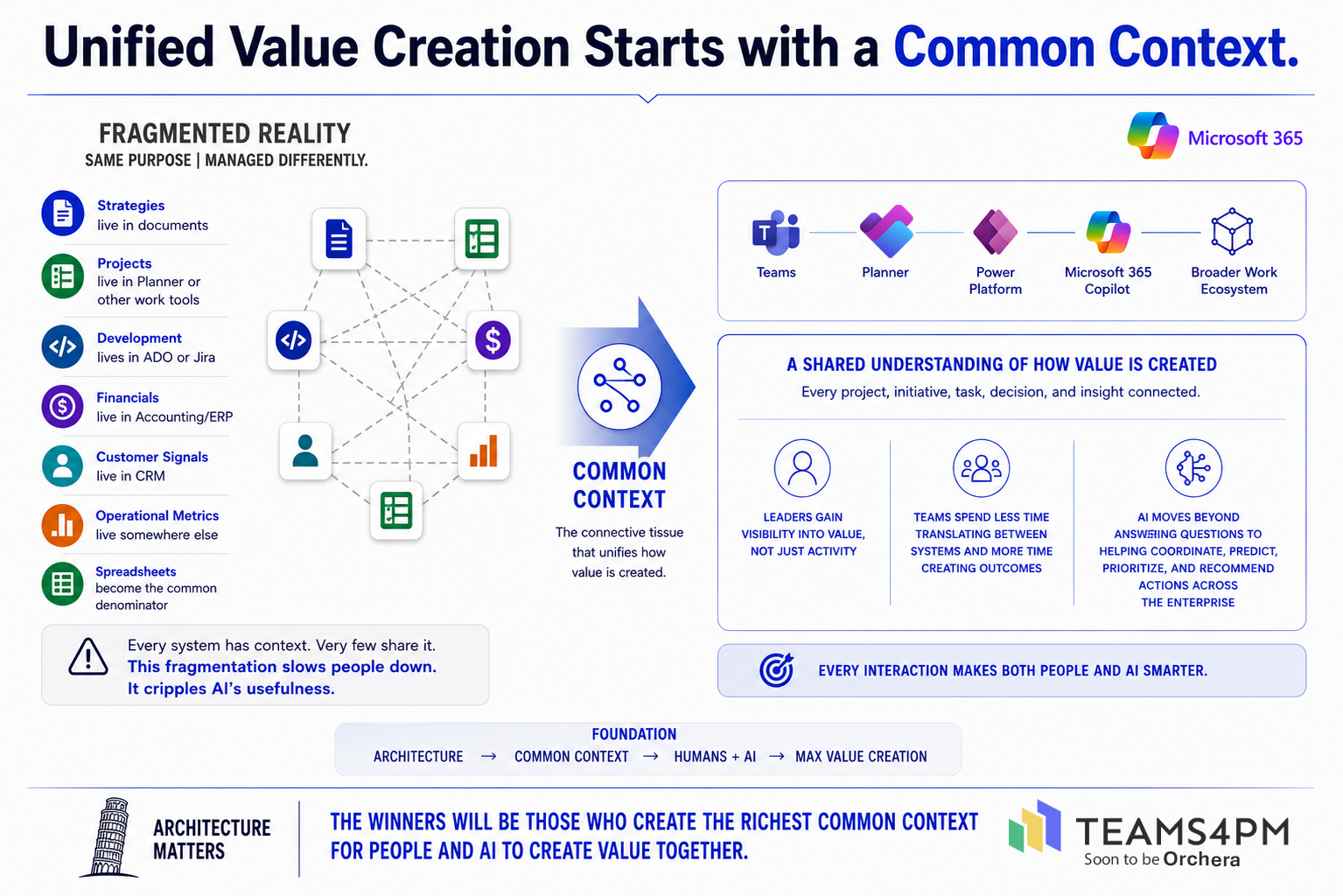
Architecture Matters PART 14: Unified Value Creation Starts with a Common Context
Every organization was formed to create value. Projects, programs, portfolios, products, operations, and innovation are quite simply mechanisms for...
1 min read
Mike Taylor
:
Updated on August 10, 2026
Like some movie franchises, I'm going backward with this installment. In Architecture Matters Part 14, I talked about why AI needs common context for Project Management.
Then I realized there’s a story before that story, so here’s prequel.
Humans needed common context long before AI shows up.
In fact, if AI didn't exist at all, we'd still have a massive problem.
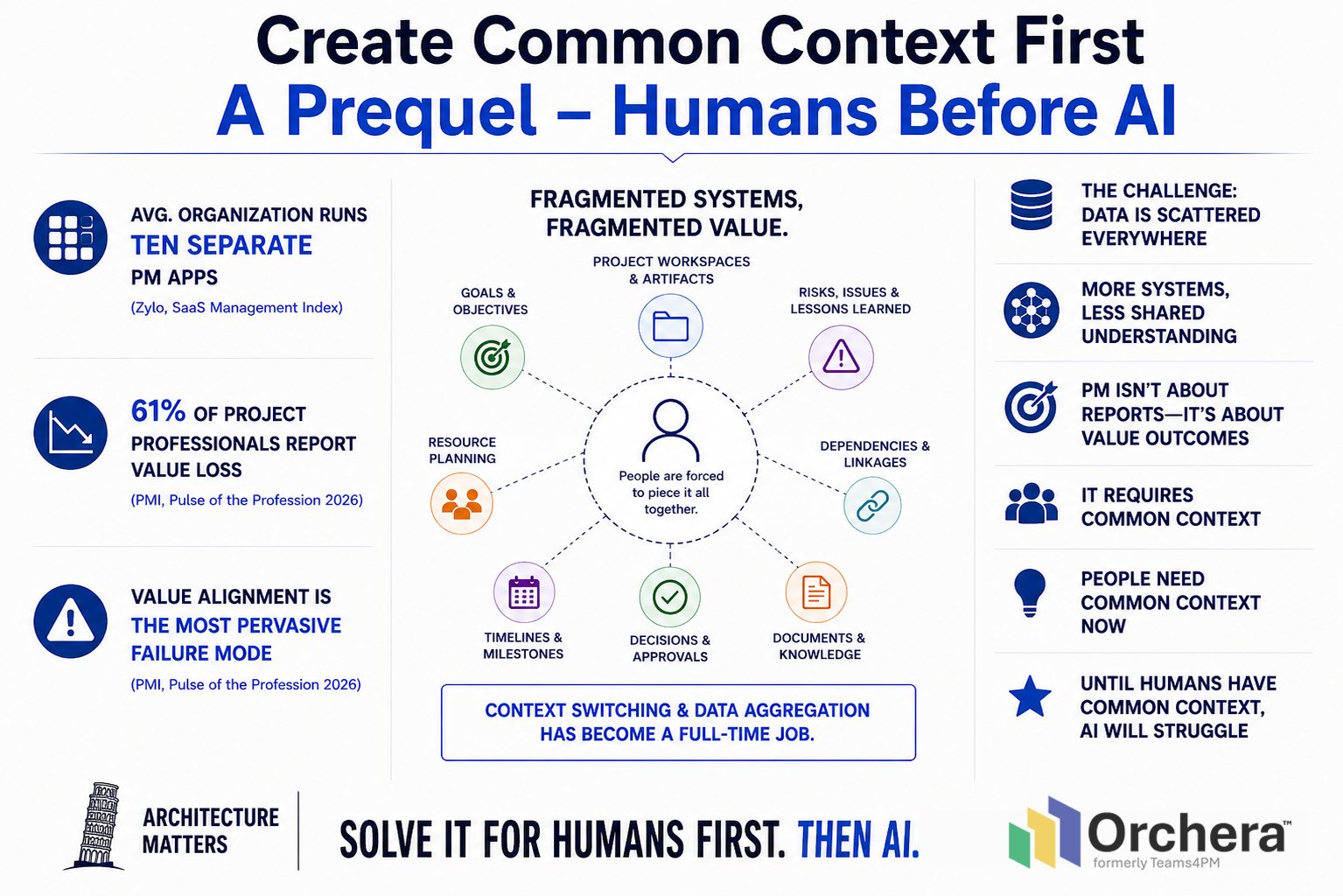
Over the last several decades, organizations have unintentionally disaggregated work across dozens of systems.
The average organization runs close to ten separate project management applications (Zylo, SaaS Management Index).
On complex projects, 61% of project professionals now report value loss - projects that deliver outputs while losing sight of outcomes (PMI, Pulse of the Profession 2026).
VALUE ALIGNMENT IS NOW THE MOST PERVASIVE FAILURE MODE IN PROJECT DELIVERY, ahead of missed deadlines and blown budgets.
FRAGMENTED SYSTEMS, FRAGMENTED VALUE.
People spend an absurd amount of time hunting for context
Executives sit through project meetings trying to reconcile conflicting information
Project managers become human integration engines
Teams bounce between applications all day trying to assemble a story that should already exist
Everyone is busy
Few are fully informed
Context switching & data aggregation has become a full-time job.
The challenge was never a lack of data. The challenge is that the data, decisions, conversations, dependencies, and outcomes are scattered everywhere.
THAT'S SEMI-ORGANIZED CHAOS.
The irony is that we've created more systems to manage work, yet many organizations have less shared understanding of the work than ever before.
Project and portfolio management ISN'T ultimately just ABOUT SCHEDULES, tasks, budgets, or reports.
IT'S ABOUT enabling people to make INFORMED DECISION to EXECUTE EFFECTIVELY TOWARD VALUE DRIVEN OUTCOMES.
And that requires something fundamental: COMMON CONTEXT.
A shared understanding of goals, priorities, dependencies, risks, decisions, progress, and VALUE. Which brings me back to AI. In Part 14, I talked about AI needing common context. But maybe that's not the best starting point.
THE REAL ISSUE IS THAT PEOPLE NEED COMMON CONTEXT NOW.
Without it, execution slows down, reporting becomes unreliable, decisions take longer, and value gets lost somewhere between systems.
And until organizations solve that challenge for humans, AI in project and portfolio management will struggle to become much more than an assistant helping us navigate the chaos.
Common context isn't just an AI requirement. It's an execution & value realization requirement.
ARCHITECTURE MATTERS!
Author's note: This post was originally shared on LinkedIn as part of a series
1 min read
Every organization was formed to create value. Projects, programs, portfolios, products, operations, and innovation are quite simply mechanisms for...
1 min read
Last month, PMI published Standard for Artificial Intelligence in Portfolio, Program, and Project Management . It’s comprehensive—275 pages.
1 min read
In 2018, Microsoft stopped trying to evolve Project Online. The scheduling engine was embedded in Planner. Microsoft’s language shifted from "PPM...